

What I've Been Reading 9
The natural world and the people in it explored by two fine poets.
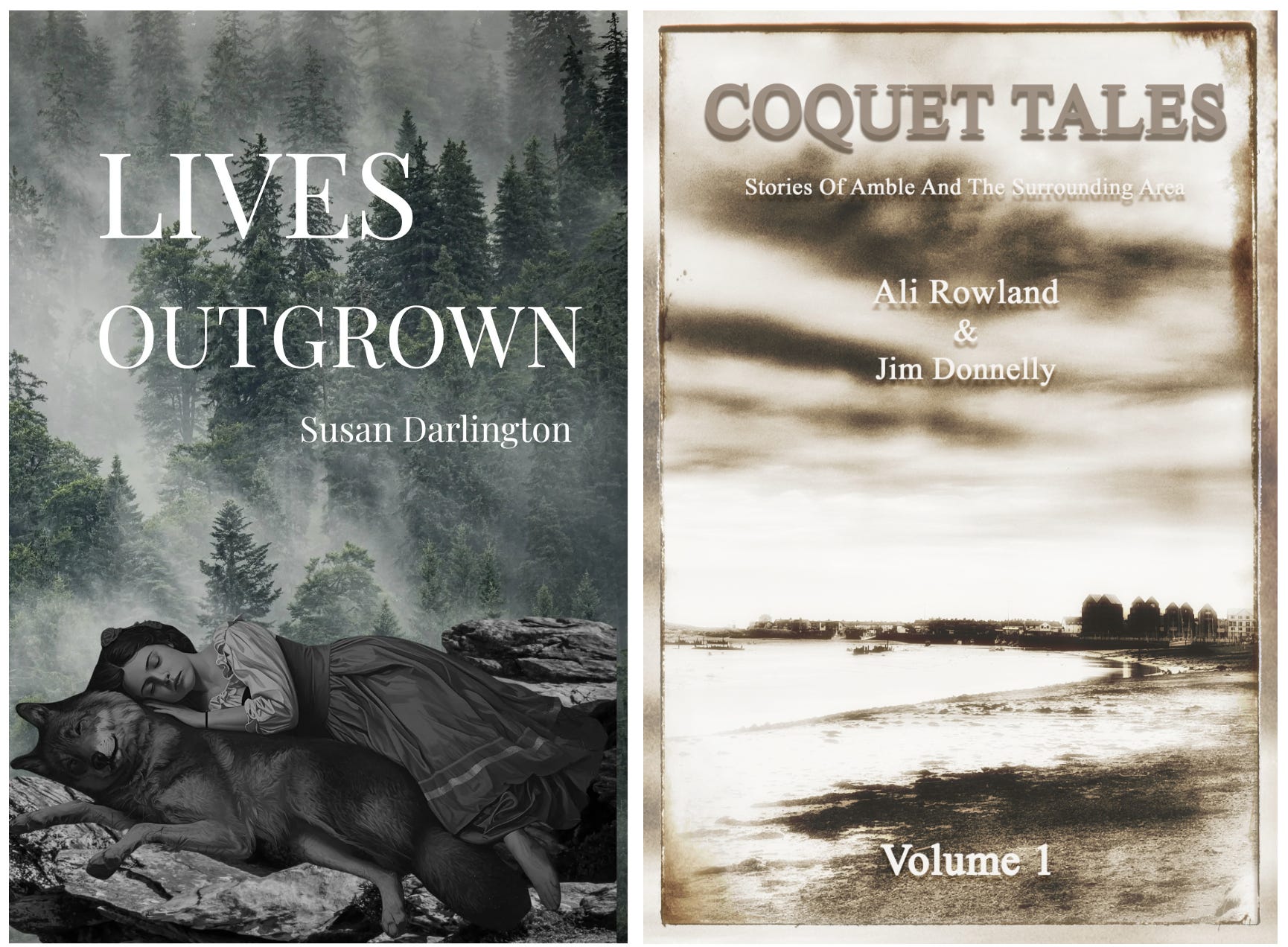
Lives Outgrown - Susan Darlington
There is a disquieting quality to Susan Darlington’s collection Lives Outgrown (Dancing Girl Press). Its dark poetry springs from the world of fairy tales, but there is little in the way of happy endings. A sense of foreboding pervades throughout, and the women who feature within its pages seem to get little respite from the awful situations which they find themselves in.
The opening piece, This is How the Story Starts speaks of unloved rather than wicked stepmothers…
Because we never blame
The father for his actions.
For his poor life choices
…and quickly goes on to deliver a shocking image of a wicked father.
Many of the women that Susan presents in subsequent poems are suffering at the hands of such men, or grieving the loss of their menfolk, who are lost at the bottom of the ocean or have fallen from the sky in flames.
I heard that she’s refused
to kindle a fire since the day
her husband lit the sky.
Susan’s stories are inspired by ideas from a range of sources including Hans Christian Anderson, Scandinavian folklore and history, and her own family, and childhood memories.
Some are drawn from letters and postcards, arranged and reflected on with a deft touch that brings not only the writing, but the physicality of the medium and the emotion of the message into sharp focus.
Others deal with animals rather than women, but in the case of the Stone Age Dog Found Buried With Its Master, and the Reindeer in Museum case, their lives have been blighted by the cruelty of men.
Not everything is bleak, there are lovely images of oven warm biscuits laid on the table, and goslings honking in symphony with their mother. But it has to be said that there is usually foreboding lurking somewhere between the lines, which flavours the whole collection and gives it a decidedly bittersweet flavour.
One of my favourite poems is full of dark mystery and is an excellent demonstration of how Susan can create a tremendous sense of atmosphere and story in a few short stanzas of poetry
Meeting With Natural History Conservator
I meet a woman at the museum
who assures me she can restore you
to almost real-life condition.

She thumbs through the wallet of photos
I hand her, eye clamped around a loupe
as she inspects for signs of damage.

The nails, she judges, will have to go.
The dentures will need to be removed,
cleaned of barnacles and re-fitted.

Everything else, she says, can be improved
with layers of adhesive, paint, clay. Cracks
in the skin smoothed with craft tissue.

A final glance over the photos and she slides
them back. Estimates she can start work
straight after Easter.


...
In addition to Lives Outgrown, Susan Darlington has had a number of number of other collections published including Under the Devil’s Moon (Penniless Press) and Never Wear White’ (Alien Buddha Press). She has also been published extensively in poetry Journals online and in print including Sixty Odd Poets, (Number 56) and the Sixty odd Compilation The Last Half Dozen. She also guest edited the Fig Tree Women’s Poetry Special along with Stephanie Bowgett.
Coquet Tales - Ali Rowland and Jim Donelly
I have been hearing a lot about Psychogeography lately. It is defined as the study of how the geographical environment affects the emotions and behaviours of individuals. Perhaps this is down to the sort of things that I read, because a search on Google Trends reveals that there are not many people reading about it or looking it up. Yet it instantly came to mind whilst reading Ali Rowland’s latest collection. Coquet Tales (Stories Of Amble and the Surrounding Area) which looks at life in and around the friendliest port in England, and is beautifully illustrated by the photographs of Ian Donnelly.
Ali often writes about the Northumberland Coast, her first collection Rooted (Maplestreet Press) was also centred on the region. She also drew heavily on the psychogeography of Sheffield in her autobiographical collection Dragged Up – A Northern Childhood, which I was proud to release through the Sixty Odd Press.
There are parallels to be drawn between Coquet Tales and Susan Darlington’s Lives outgrown. Both have a sense of landscape, and the lives of the people living within it. Ali’s tales have a modern twist. The town has changed from an unattractive industrial one, to a popular seaside resort with a thriving arts community. But the older generation are still there with their observations and stories.
One such person is The Boatman, a sinister Charon like character who offers to ferry folk over to a medieval hermits cave nearby. Another in The Fisherman’s Tale, is keen to discuss sex and death amongst ducks with a couple who are distracted as
A million insects heat seek us as a prospect
For a bloody feast as the sun goes down
The topic of how the natural world suffers at human hands is another theme which comes across strongly. In Seagulls and Crisps, Ali comments that…
The relationship between people and other life forms. It’s complicated.
There is also the sense that something is lacking in the modern world, with its obsession with appearances. This is introduced in Do you know that Really big Family? A really amusing piece with a twist at the end. She observes that they do a lot of preening…
I suppose that’s the influence of celebrity culture and these influencer types on Social Media
Elsewhere, she speaks of social media being away from the solid world, in the ether. And in Peace Please Darling, she speaks of the Northumbrian heroine, Grace Darling craving the calm seclusion of an ancient Hermitage
Sadly for her, liking quiet and wholesome pastimes was already going out of fashion.
The poem Phantoms Ancient and Modern shows how skilfully Ali blends history with the present day, finding themes which resonate through the ages.
Ali Rowland
Shape shifters came at the witching hour –
though hours, like witches, were yet to be invented.
Their forms were bleak, diaphanous,
darkness shivered in their hearts,
eyes sizzling with gruesome plans for early man.

They broke off rocks to make an island,
easy as a child un-building blocks,
and then waded, footfalls exposing layers of sand and coal;
giants in amorphous bodies that could barely hold their forms.

On dark, dreich nights they moved like plagues,
 rehearsing curses beneath the breath –
names, invocations, spells, incantations;
death drafts and toxic imprecations simmering in their sour, wet spit.

Draw back from them,
cloak yourself in shadows,
avoid the sinkholes where they trod,
but most of all,
keep not their company in its modern guise –
the gossips, the intolerant, the haters, and the unkind.
If you would like me to review something of yours, have a word with me, online or in real life. Sending me a PDF copy would be very useful.
Thanks Mike, for a great review. It’s good to know that the collection ‘travels’ well and that you enjoyed reading it.